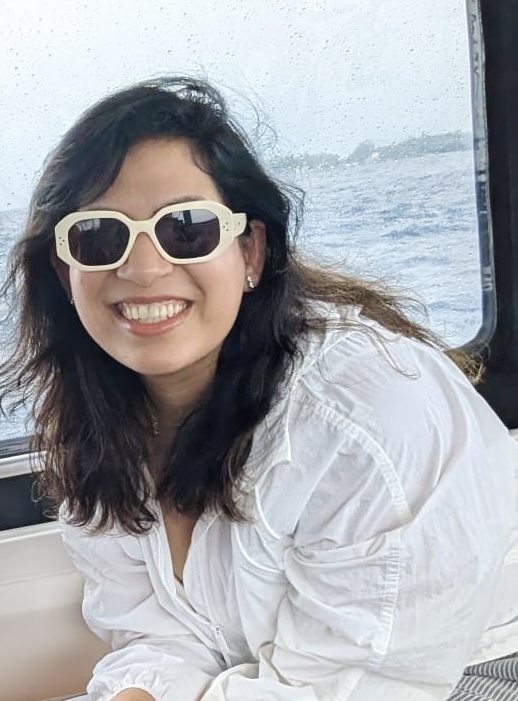
Founder & applied AI scientist

Akansha
Singh Bansal.

I’m building phirky.ai to help Bay Area families plan a day out.

Before taking my toddler and our dog somewhere new, I’d piece together opening hours, dog policies, and travel times from different sites.

I’m drawn to AI that makes everyday decisions easier. I work on the whole product, from checking the information behind a recommendation to designing how a parent chooses where to go.

Akansha Singh Bansal
San Francisco Bay Area
Building now
Founder, phirky.ai
Product design & engineering
Previously
Bayer Crop Science R&D
Scientific AI · 2023–2026
Research foundation
Ph.D., Computer Engineering
UMass Amherst · 2021

01 / Independent work

What I’m building

phirky.ai · Founder · Since July 2026

A family day out.
With the details worked out.

I started by bringing library events, park programs, and museum calendars into one place. Families can browse what’s on or ask the planner for an outing that fits their day.

A plan takes shape around the children’s ages, who’s coming along, and the time between stops. Parents can follow a listing back to its source to check the details before they leave.

I design the experience, build the data pipelines, and run the product.

Explore phirky.ai

The problem I’m working on

“What can we do before nap,
with the dog?”

A park might welcome dogs on its trails and keep them out of the playground. Details like that shape how I organize the data and what I show a parent choosing between two stops.

Why I started it

02 / Experience

From solar forecasting to scientific AI

During my Ph.D. at UMass Amherst, I used satellite imagery to forecast solar power. Later, at Bayer, I built a platform for generating scientific reports and led an engineering team developing memory for a research assistant. The question I carry into phirky.ai is how to help someone judge whether a model’s answer is good enough to act on.

Bayer Crop Science R&D

June 2023–October 2026

Data Scientist / Applied Generative AI

I built AI tools for scientists working with research data, reports, and unfamiliar codebases. The work included production delivery, model comparison, evaluation, and engineering leadership. Earlier work contributed to digital-twin research using deep learning and satellite imagery to forecast traits from spatiotemporal observations.

Scientific report generation
Developed an LLM report-generation platform through its third major release, with multiple models, semantic search, and built-in evaluation. Used in daily scientific workflows.
Natural-language data access
Built agent interfaces for querying complex R&D datasets in plain English.
Codebase intelligence
Developed tools to help researchers understand unfamiliar code and get started with existing analytics projects.
Conversational memory & team leadership
Led a small engineering team on the design and delivery of hierarchical short- and long-term memory for an organization-wide assistant.

Gro Intelligence

April–May 2023

Research Scientist

Developed machine-learning models using satellite data to identify crop masks and estimate crop yields.

Colorado State University

CIRA · NSF AI2ES · January 2022–March 2023

Machine Learning Scientist / Postdoctoral research

Developed U-Net models using GOES satellite observations to identify atmospheric convection and compared their outputs with ground observations. Explored diffusion-based foundation models for the spatial and temporal structure of satellite data, alongside research on trustworthy AI for environmental science.

Related research

Oak Ridge National Laboratory

June–August 2021

ORISE Research Intern, GeoAI Group

Developed machine-learning models for gravity anomaly mapping and explored explainable AI techniques to analyze their performance.

University of Massachusetts Amherst

2015–2021

Graduate Research Assistant, Computer Engineering

Studied data-driven control, modeling, and forecasting for residential solar power. My research included self-supervised learning on multispectral satellite data, software-defined solar systems, and the costs and carbon emissions of grid defection.

Related research

Nanyang Technological University

Singapore · 2014–2015

Research Associate, School of Computer Science

Worked on mixed-criticality real-time operating systems using LITMUS RT and on cell-balancing algorithms for smart batteries.

03 / Education

The academic foundation

2011–2014

M.S. by Research, Information Technology

International Institute of Information Technology Bangalore

Thesis: Health Monitoring for Smart Grid Network for Prevention Against Failures. Research on smart-grid communication, health monitoring, and network resilience.

2007–2011

B.Tech, Computer Science

Maharshi Dayanand University, Rohtak

My research spans trustworthy AI, learning from satellite imagery, solar forecasting, and energy systems. Selected work is below; the full research record includes earlier work on smart grids and software-defined solar systems.

  1. 2023

    Trust and Trustworthy Artificial Intelligence: A Research Agenda for AI in the Environmental Sciences

    Risk Analysis · Coauthor

  2. 2023

    Leveraging Spatiotemporal Information in Meteorological Image Sequences: From Feature Engineering to Neural Networks

    Environmental Data Science · First author

  3. 2022

    A Moment in the Sun: Solar Nowcasting from Multispectral Satellite Data using Self-Supervised Learning

    ACM e-Energy · First author

  4. 2020

    See the Light: Modeling Solar Performance using Multispectral Satellite Data

    ACM BuildSys · Honorable mention, best presentation

05 / Beyond the project

Speaking, teaching, and service

Speaking

I’ve given invited talks at Stanford University, Lawrence Berkeley National Laboratory, PARC, Oak Ridge National Laboratory’s GeoAI Group, and UW–Madison’s Energy Analysis & Policy program.

Other presentations include the ESST Transformers Workshop, the AMS Annual Meeting, and an internal workshop on working with LLM APIs.

Teaching & mentoring

At UMass Amherst, I created and independently taught ENGIN 191, Staring at the Sun: An Introduction to Solar Energy.

I also served as a teaching assistant for graduate and undergraduate courses, completed CIRTL teaching certifications, and have mentored junior scientists and interns.

Research service

Peer reviewer for AI and energy-systems venues. Technical program committee member for FATEsys 2021.

Recognition

  • Honorable mention, best presentation
    ACM BuildSys · 2020
  • Second prize, Data Analytics Lightning Talks
    Duke Energy · 2020
  • Third prize, Three-Minute Thesis
    UMass ECE · 2021